

By: Christina Fitzgerald and Darshana Indira
In its recent Anaplan Parent, LP v. Brennan decision, the Massachusetts Supreme Judicial Court held that a parent company's signature on a noncompete agreement does not satisfy the requirements of the Massachusetts Noncompetition Agreement Act.
Key Takeaways
- In Anaplan Parent, LP v. Brennan, SJC-13917 (Nov. 17, 2026), the Massachusetts Supreme Judicial Court ("SJC") held that a noncompete signed by an employee and the employer's corporate parent does not satisfy the Massachusetts Noncompetition Agreement Act's requirement that the agreement be "signed by both the employer and employee."
- For purposes of enforcing noncompetition agreements in Massachusetts, an "employer" is, at minimum, the entity for which an employee actually performs services. Identifying the employer as a third-party beneficiary of the agreement does not eliminate the requirement that the employer sign it.
- The decision does not bar a parent from enforcing a noncompete against a subsidiary's employee. It requires that the Act's minimum requirements, including the employing entity's signature, be met.
- The ruling is limited to noncompete agreements. The court noted that the Act does not govern confidentiality, nonsolicitation, or nondisparagement covenants.
The Massachusetts Noncompetition Agreement Act ("MNAA"), G. L. c. 149, § 24L, took effect on October 1, 2018. Since then, Massachusetts courts have continued to interpret the Act and clarify its requirements for enforceable noncompetition agreements.
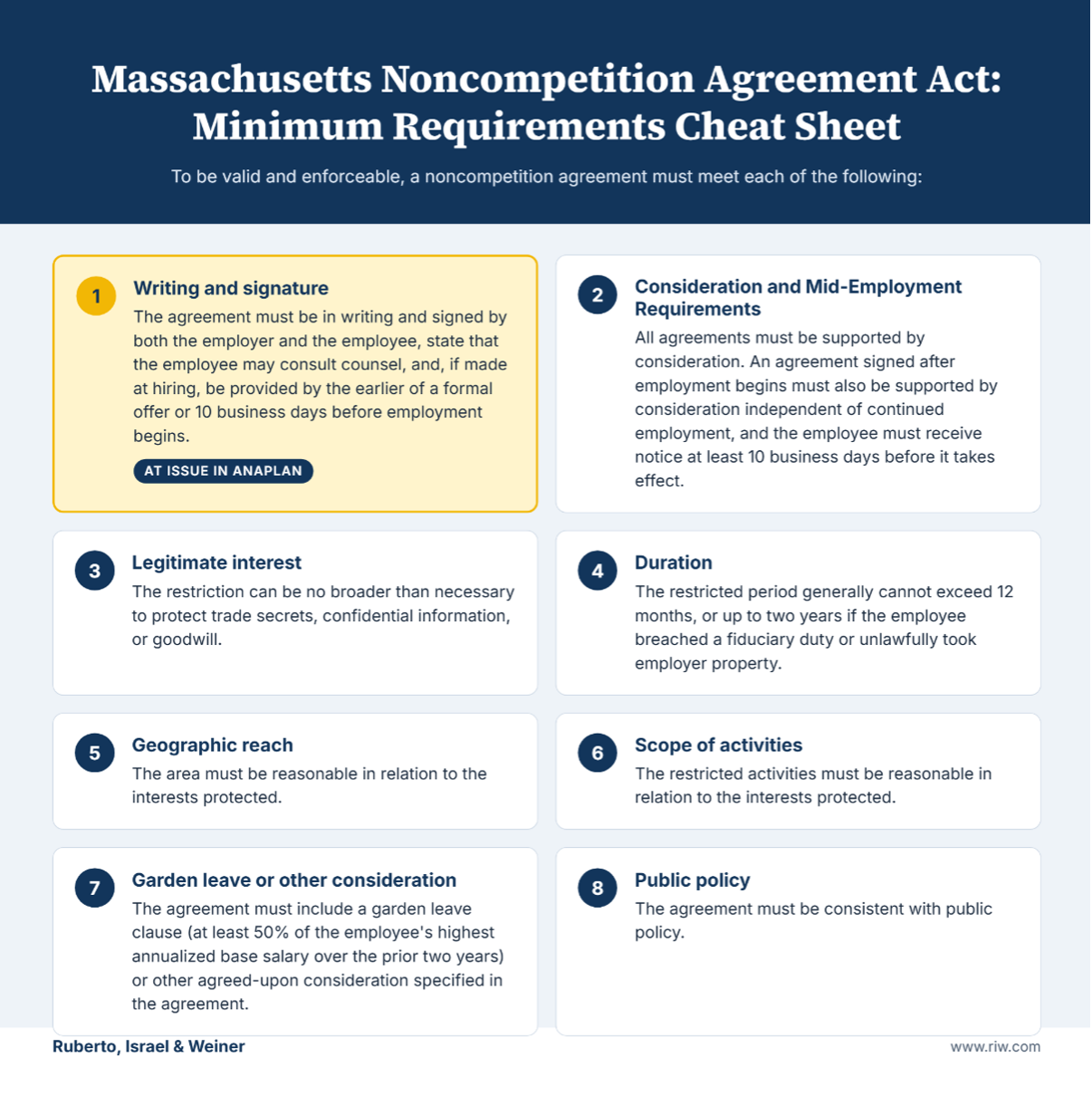
To be valid and enforceable, a noncompetition agreement must meet each of the MNAA's minimum requirements:
Background
Timothy Brennan joined Anaplan, Inc. in 2019. Between 2022 and 2024, he signed three equity incentive agreements with Anaplan Parent, LP—the direct employer's "great-grandparent" entity—each containing a twelve-month noncompete. Brennan and the parent company signed the agreements, but Anaplan, Inc., the entity that employed him, did not. Instead, the agreements identified the direct employer as a third-party beneficiary.
When Brennan left in July 2025 for a competitor, the employer's parent company and subsidiary sought a temporary restraining order and preliminary injunction in Superior Court. The judge denied relief because Brennan's employer had not signed the noncompete agreements and rejected the parent company's argument that the agreements fell outside the MNAA. The SJC transferred the companies' appeal on its own initiative and heard arguments on September 9, 2026.
On appeal, the SJC took up two principal questions. The first was whether an agreement signed by the employee and the employer's corporate parent, but not by the employer itself, satisfies the MNAA's requirement that the agreement be signed by both the employer and the employee. The second was whether covenants of this kind are excluded from the Act altogether as "noncompetition agreements outside of an employment relationship," and therefore, not subject to the signature requirement.
SJC Clarifies Meaning of "Employer" and Scope of the MNAA
The MNAA does not define "employer," leaving the SJC to interpret the term by examining the statute's language. The Act defines "employee" by reference to the independent contractor statute, G. L. c. 149, § 148B. Because an employee is someone who performs services for an entity, the court reasoned that an employer is, at minimum, an entity for which an individual performs any service. The court supported that reading by referencing dictionary and statutory definitions of "employer," including those in the unemployment insurance and workers' compensation statutes.
The companies urged the court to adopt the broader definition of "employer" under G. L. c. 149, § 1, but the court declined to import it here. Writing for the court, Justice Dalila Wendlandt reasoned that that definition is expressly applied to other statutory provisions and the Legislature did not extend it to the section at issue here (§ 24L). The court also rejected the parent company's argument that its active role in the subsidiary made it a joint venturer with respect to Brennan, noting that the record did not show a joint venture and the entities had kept separate corporate forms. As the court put it, "[h]aving taken advantage of the benefits of this separateness, they may not disavow that form when it is to their advantage." Anaplan, slip op. at 18.
The MNAA excludes noncompetition agreements "outside of an employment relationship." The companies argued that because the parent was not the employer, its covenants fell outside the Act. The court disagreed, holding that an agreement is not outside the employment relationship simply because the employer did not sign it. The court noted that the covenants were entered into in connection with Brennan's employment by the subsidiary, restricted competition with that subsidiary after his employment ended, identified the subsidiary as a third-party beneficiary, and provided Brennan with equity in exchange for the restrictions. The subsidiary's beneficiary status was therefore evidence that the agreements arose out of the employment relationship, not a substitute for the employer's signature.
The court also rejected the argument that enforcing the requirement handed the employee a windfall over a technicality, stating that policy arguments of that kind belong before the Legislature.
Building on Massachusetts Noncompete Case Law
This most recent Supreme Judicial Court decision provides an important contrast to another recent decision addressing the MNAA's formal requirements.
A federal court recently enforced a Massachusetts noncompete in Fresenius USA Manufacturing, Inc. v. Much, No. 1:26-cv-13572 (D. Mass. Sept. 23, 2026). There, the employee also argued that his twelve-month noncompete agreements were not signed by his employer. In Fresenius, however, the agreements defined the "Employer" as the subsidiary that employed him, and representatives signed "on behalf of the Employer." Because the agreements identified his actual employer and were signed on behalf of that employer, the court found the signature requirement met, granted a preliminary injunction running through July 24, 2027, and rejected his argument that the restrictions were overbroad, since they applied only where his new duties were the same as or substantially similar to his prior ones.
Although Fresenius addressed the employer-signature requirement, it did not resolve whether a parent company can enforce a noncompete against a subsidiary's employee. In Anaplan, the SJC clarified that its decision does not prohibit enforcement by a parent company, provided the Act's minimum requirements, including the employing entity's signature, are satisfied. Both decisions underscore the importance of identifying the actual employer and ensuring that the agreement is signed on its behalf.
Although the SJC clarified the employer-signature requirement, several related issues remain unresolved, including:
- Corporate disregard and joint employment: The court acknowledged both doctrines but noted that neither party argued they applied. The court also observed that the parent did not hire, fire, supervise, pay or maintain employment records for Brennan.
- Severability and cure: The opinion does not address severability. It addresses reformation under § 24L(d) only to say that the provision is not a rule of construction for defining "employer."
- Multiple employing entities: Although the court recognized the possibility of joint employment, it did not address whether each employment entity must sign a noncompetition agreement to satisfy the MNAA's signature requirement.
Practical Considerations for Employers
Using Anaplan as a guide, employers should:
- Ensure the direct employer signs the noncompetition agreements. Relying solely on a parent entity's signature or identifying the employer as a third-party beneficiary may render a noncompete agreement unenforceable.
- Audit parent-level equity and incentive agreements. Employers should review applicable employment agreements containing noncompetition provisions for their Massachusetts employees, including profits-interest and stock option awards, and confirm whether the employing entity signed.
- Revisit agreements following corporate transactions. Employers should review existing noncompetition agreements following mergers, acquisitions, internal reorganizations, or employee transfers between affiliated entities to determine whether new agreements are necessary.
- Treat remediation with care. A replacement noncompete signed mid-employment must also satisfy the MNAA's requirements for agreements entered after employment begins, including independent consideration and timely notice. The SJC did not address whether defective agreements can be cured, so any revisions should be evaluated for compliance against those requirements.
- Keep other protections in place. Confidentiality and nonsolicitation covenants typically fall outside the MNAA and are not within the scope of the SJC's decision in Anaplan.
- Avoid relying on choice-of-law provisions. Employers should not assume that selecting another state's law in a parent-level equity incentive agreement will circumvent the MNAA's requirements for Massachusetts employees.
Employers with questions regarding noncompetition agreements or other restrictive covenants are encouraged to contact an RIW employment attorney for additional information.
(This alert is for informational purposes only and may be considered advertising. It does not constitute the rendering of legal, tax, or professional advice or services. You should seek specific, detailed legal advice prior to taking any definitive actions.)
Darshana Indira is a shareholder of the firm and a member of the Corporate Department and Employment Law Group, where she focuses her practice on advising company owners, organizational leaders, and C-suite executives on employment and business matters. Her employment practice includes counseling employers on workplace issues and advising businesses and executives on employment agreements, executive compensation, restrictive covenants, and severance. Darshana also advises startups and established businesses on entity formation, governance, commercial agreements, and other transactional matters, as well as employment and business disputes when they arise. You can reach Darshana at [email protected] or (617) 570-3540.
Christina Fitzgerald is a member of the firm's Litigation Department, where she represents individuals and businesses in a variety of matters. She has experience in all phases of litigation, ranging from initial pleading and motion practice to settlement, trial, and appellate work. You can reach Christina at [email protected] or (617) 570-3543.